
The Continuous Exploitation of U.S. Workers
Brought to You by Policy and Profit
Worker exploitation, it’s easy to picture sweatshops overseas or the harsh conditions of the Industrial Revolution, but it’s not a relic of the past or a distant problem. It’s happening right here, right now, baked into policies and business practices that keep workers financially vulnerable and tied to situations they can’t afford to leave.
It is visible in the stagnant wages that haven’t kept up with the cost of living. In the way companies replace employees with “contractors” to cut costs, while shifting all the risk onto them. In a system that ties healthcare coverage to employment, making it nearly impossible to walk away from a bad job without putting your family’s well-being on the line. These aren’t isolated issues. They’re part of a system designed to keep workers in a constant state of dependency, with just enough to survive, but never enough to have any real leverage.
A System Built to Keep Workers in Place
Imagine playing a game where the code was written decades ago, but the rules and technology have completely changed. That’s what today’s labor system feels like. Policies that were supposed to create a fair workplace haven’t been updated to reflect modern realities, and businesses have adapted to take full advantage.
Take wages. The federal minimum wage has been stuck at $7.25 since 2009, and thanks to inflation, it’s worth far less than it was back then. Tipped workers? They’re still making as little as $2.13 an hour, a policy originally designed after the Civil War to allow businesses to avoid paying Black workers a fair wage. Today, it continues to leave millions of service workers at the mercy of customer whims.
And then there’s job classification. A growing number of workers, from Uber drivers to freelance writers to construction crews, are labeled as independent contractors, which means no guaranteed wages, no benefits, no job protections. While flexible work has its perks, most people aren’t picking up multiple gigs because they love the grind. They’re doing it because a single paycheck isn’t enough to survive. And companies know it, which is exactly why they’ve leaned into this system.
But say you make a decent wage, the system has other ways to keep you tied to your job. One of the biggest? Healthcare.
Nearly half of Americans rely on employer-sponsored insurance, which means losing your job doesn’t just mean losing income, it means losing access to medical care. This setup keeps people tied to a job that isn't advancing them, afraid to leave even when the work environment is toxic or unsafe. It also makes it harder to push back against bad policies or demand better wages. When your family’s health is on the line, the ability to walk away isn’t really an option.
Of course there’s also the hustle culture, which has been rebranded as “entrepreneurship”. Working over 40 hours to get ahead is required to demonstrate your “dedication” to your job and defines your “future potential”. Gig work and side hustles are framed as “financial freedom,” but in reality, most people aren’t juggling multiple jobs because they want to. They’re doing it because one paycheck doesn’t cut it anymore. Meanwhile, corporations continue profiting off the instability, raking in record revenues while cutting costs at workers’ expense.
Even outside traditional workplaces, labor exploitation is thriving. Incarcerated workers earn pennies per hour to do essential jobs, from fighting wildfires to staffing call centers. Some people call it “rehabilitation,” but let’s be real, when private prisons profit from cheap labor, there’s a strong incentive to keep the system churning. And once those workers are released? They’re funneled right back into low-paying, insecure jobs (if they are lucky), making it nearly impossible to break the cycle.
However, in some cases companies make your employment choices for you, implementing everyone’s favorite cost savings exercise: layoffs. Even in industries where workers are paid fairly and revenue is solid, job security is an illusion. Companies like Amazon and Google continue to bring in record-breaking profits and then turn around and slash thousands of jobs in the name of “efficiency.” It’s not about survival, it’s about maximizing shareholder value. Workers are left scrambling, competing for fewer jobs while being told to “just reskill” or “embrace the gig economy.” It’s a cycle that keeps labor cheap and disposable while funneling wealth upward.
When workers do start questioning the system, those in power are ready with a distraction. Instead of addressing wage stagnation or job insecurity, you are told to “just work harder” or “learn to code.” If that doesn’t work, they may pit workers against each other (men versus women, blue-collar versus white-collar) so we’re too busy fighting among ourselves to demand real change.
Employer-Level Changes Aren’t Enough
It’s tempting to frame worker exploitation as a problem caused by “bad employers” or corporate greed alone. However, focusing solely on individual companies misses the larger truth: exploitation is a feature of the system itself, not a bug. Even employers who want to prioritize fair wages, benefits, or stable jobs often face structural barriers that make systemic change impossible to achieve on their own.
- Market pressures and the profit imperative. Employers operate within a profit-driven ecosystem where competition dictates survival. If one company raises wages or offers better benefits, it risks being undercut by competitors who prioritize cost-cutting. Shareholders demand ever-higher returns, and executives face pressure to prioritize short-term gains over long-term investments in workers. This creates a race to the bottom: companies that try to “do the right thing” may lose market share, face investor backlash, or struggle to attract capital. For example, a retail chain that raises wages without industry-wide standards could see profits shrink, leading to layoffs or closures. Truly a lose-lose scenario.
- Outdated rules and collective inaction. The legal and regulatory framework governing labor hasn’t kept pace with economic shifts. Labor laws written for factory workers in the 1930s fail to protect gig workers today. Tax structures incentivize outsourcing and contracting. Healthcare systems tied to employment make comprehensive benefits a financial burden for smaller businesses. Even well-intentioned employers are boxed in by these policies. Without universal healthcare, for instance, a small business providing full coverage may struggle to compete against larger firms that offload costs onto taxpayers or workers.
Some companies tout “pro-worker” policies (modest raises, tuition assistance, or wellness programs), but these are often band-aids, not solutions. A corporation might raise wages while lobbying against minimum wage increases industry-wide, ensuring competitors don’t follow suit. Others might offer mental health benefits while opposing regulations that would curb exploitative scheduling practices. These piecemeal changes rarely address the root issue: a system that treats labor as a cost to minimize, not an asset to invest in.
Interlocking Systems of Exploitation Require Systemic Change
Worker vulnerability is reinforced by overlapping systems. For example:
- Housing and Debt: Stagnant wages collide with skyrocketing rents and student debt, forcing workers to accept unstable gigs.
- Criminal Justice: Employers in industries like warehousing or agriculture rely on formerly incarcerated workers who have few alternatives, perpetuating cycles of low-wage labor.
- Globalization: Companies outsource labor to countries with weaker protections, depressing standards everywhere.
No single employer can dismantle these interconnected structures. A factory owner paying fair wages still can’t undo the global race-to-the-bottom in manufacturing. A tech CEO offering parental leave can’t single-handedly reverse the erosion of worker power caused by decades of anti-union policies.
This isn’t to absolve employers of responsibility, but to recognize that meaningful progress demands collective action. Employers, like workers, are constrained by the rules of the game. Raising wages at one company won’t fix healthcare tied to jobs. Unionizing a single warehouse won’t rewrite labor laws that let corporations classify workers as contractors.
This Affects Everyone, Even If You’re Doing A-Okay
It’s easy to think, “This isn’t my problem, I have a good job.” But worker exploitation doesn’t just hurt the most vulnerable. It ripples through the entire economy.
When companies can get away with paying warehouse workers $15 an hour with no benefits, it lowers the wage expectations for everyone else. Job insecurity means even high earners are less likely to push for raises or demand better working conditions. Student debt and rising healthcare costs keep workers chained to jobs they don’t want, making it harder to take risks, start businesses, or pursue careers they’re passionate about.
This isn’t simply about fairness, it’s about economic stability. A workforce that’s constantly on edge, trying to stay afloat, isn’t one that can drive innovation, build strong communities, or create long-term growth. The more workers are squeezed, the more the economy as a whole suffers.
The fight isn’t against individual companies, it’s against the rigged game they’re forced to play, and those in roles of power who refuse to change the rules.
What We Can Do About It
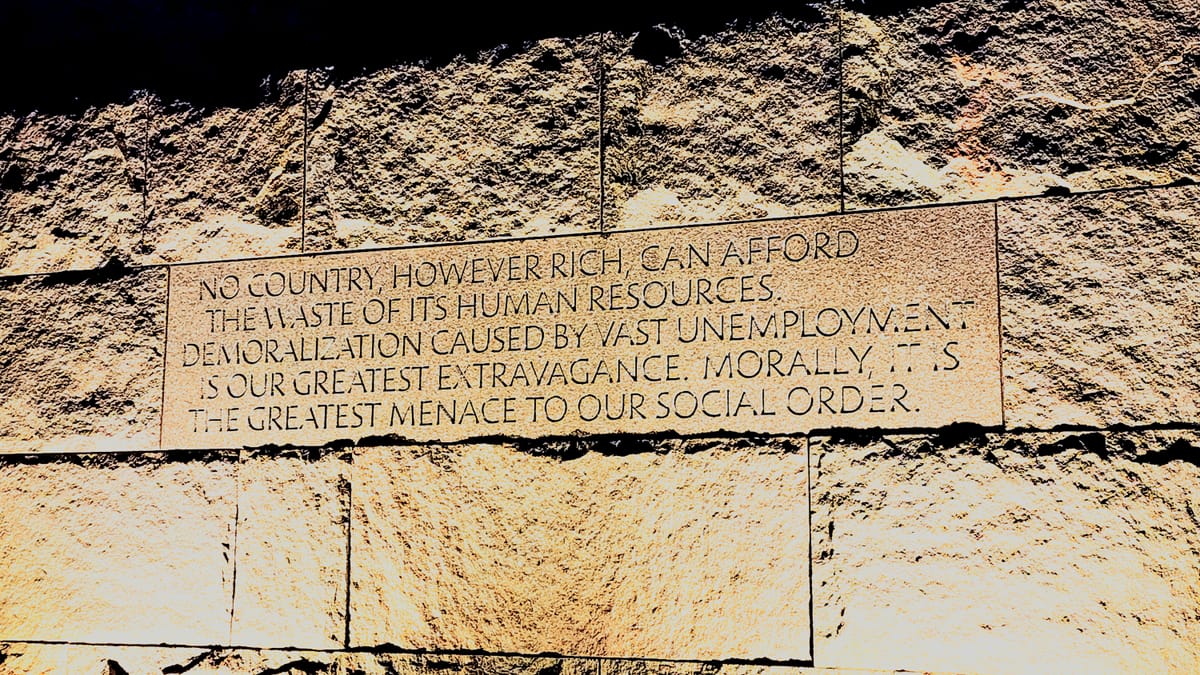
The 32nd president of the United States, Franklin Delano Roosevelt, once said “No country, however rich, can afford the waste of its human resources. Demoralization caused by vast unemployment is our greatest extravagance. Morally, it is the greatest menace to our social order.”
History has shown us that workers win when they recognize their shared struggles and push back. The 40-hour workweek, child labor laws, and workplace safety regulations weren’t gifts granted by the corporations, they were won through collective action. We’re seeing that same energy today.
The battle for $15 has already pushed dozens of states to raise their minimum wage. Starbucks baristas and Amazon warehouse workers are unionizing, despite aggressive anti-union campaigns. Conversations about universal healthcare and student debt relief are gaining traction. None of this happens overnight, but it proves one thing: when workers come together, they have power.
So what do we do? First, we call out the contradictions. When companies claim to “care about workers” but lobby against wage increases, we push back. When politicians claim to support job creation but refuse to invest in worker protections, we hold them accountable. And when businesses frame layoffs as “necessary,” we ask, “necessary for who?”.
Real change requires rewriting the rules themselves: updating labor laws, decoupling benefits from employment, and rebalancing power between capital and labor. Until then, even the most progressive employers will remain trapped in a system that rewards exploitation.
The Truth About Power
Worker exploitation isn’t some inevitable reality. It’s a conscious choice. A profitable one. Every time we accept layoffs as “just business” or let corporations frame gig work as “the future,” we reinforce a system that values profit over people.
But here’s the thing: the economy doesn’t run without workers. Every product made, every service delivered, every profit earned, it all depends on labor. When workers stop playing by the rules designed to keep them powerless, the entire system shifts.
Take action by supporting worker-led movements, voting for policies that protect labor rights, advocating for employee-centered practices at work, and refusing to accept the status quo as “just the way things are”. Each action helps shift the balance of power in favor of everyday Americans.
To be clear, this isn’t about charity. It’s about recognizing that economic fairness benefits everyone. When workers have security, autonomy, and real choices, we all win. And in a rigged game, solidarity isn’t just an ideal. It’s the only way to change the rules.